
Prove SOP Continuity in 30 Days for Ops with Knowledge Verification

Knowledge verification confirms an SOP is accurate, has a named owner, and can be executed by someone other than the person who wrote it. If your operation runs on documents nobody has stress-tested, the first move is simple: assign an owner to each critical process and run a live trial, ideally with a successor rather than the original expert. This article walks through the workflow, the checklist, and the governance model that make that verification stick.
TL;DR:
- Assigning a clear owner and conducting live trial runs help catch ambiguous instructions and prevent process outages or compliance issues.
- Prioritizing SOPs by risk and recent review date ensures focus on the most critical documents for timely verification.
- Implementing a lightweight governance structure with a steward and SME reviewers accelerates updates and maintains document accuracy.
- Regular micro-reviews and metadata tracking facilitate quick checks and early detection of outdated or risky documentation.
- Using a dedicated platform that provides verification status and dependency insights reduces key-person risk and supports process resilience.
Table of Contents
- Why Verifying Operational Knowledge Reduces Risk
- The Four Core Principles Behind Effective Verification
- A Repeatable Knowledge Verification Workflow You Can Run in a Week
- Audit Checklist and a 10 to 15 Minute Micro-Review Script
- Who Owns What, and How a Governed Platform Helps
- A 30-Day Sprint to Prove Verification Works
- What Actually Goes Wrong With Verification Projects
- Where MindVault Fits Into Your Verification Process
- Sources
- FAQ
Why Verifying Operational Knowledge Reduces Risk
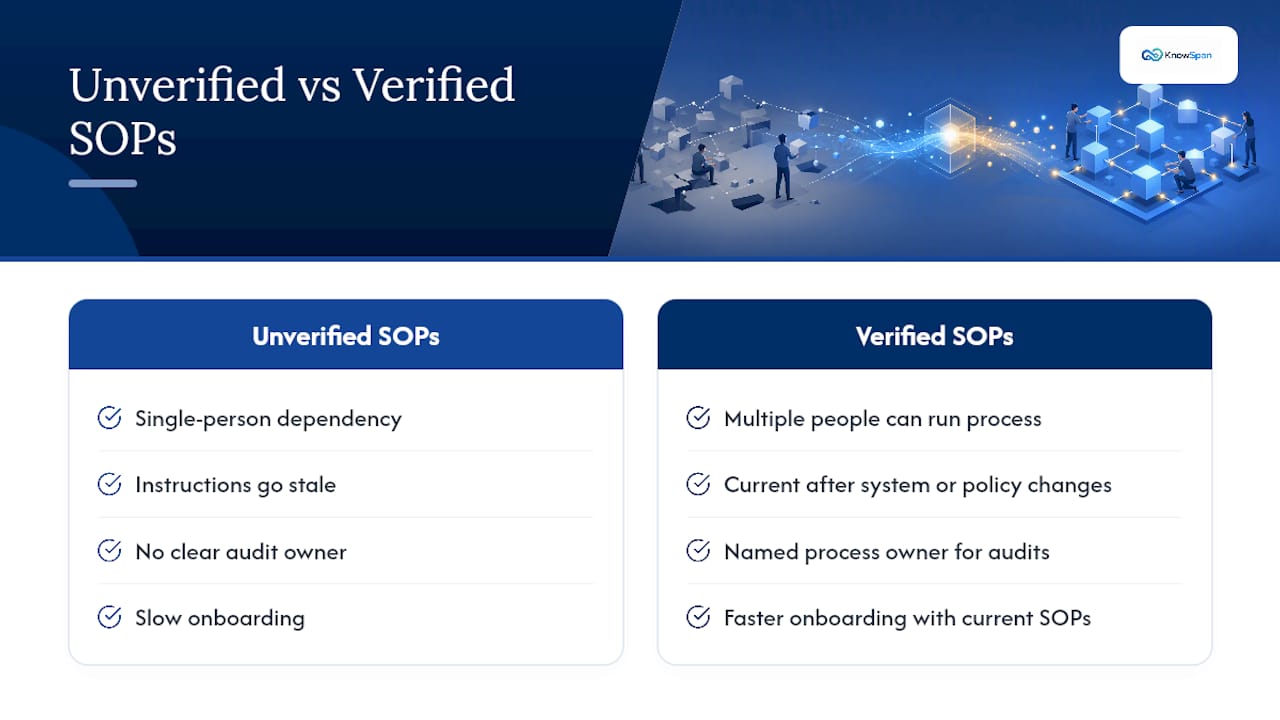
Unverified SOPs create three specific problems. One person becomes the only one who can actually run a process. Instructions go stale the moment a system or policy changes. And when an auditor asks who owns a procedure, nobody has a clean answer.
Verification fixes this by forcing a reality check. Someone other than the author has to follow the steps and prove they work. That single act catches ambiguous instructions before they cause an outage, a missed compliance deadline, or a botched client handoff.
It also speeds up onboarding. New hires who inherit verified, current SOPs ramp up faster than ones handed a folder of documents nobody has touched in two years. Building a documentation steward and SME reviewer structure alongside a named process owner gives you a repeatable way to catch drift before it becomes an incident, rather than after.
Quick fact: teams that assign three distinct governance roles, an accountable owner, an operational steward, and consulted SME reviewers, tend to catch outdated steps faster than teams relying on one person to "own documentation" in general.
The Four Core Principles Behind Effective Verification
Before you pick software or redesign your wiki, get these rules straight.
Every SOP needs a named owner, not a department. "Operations owns this" means nobody owns it. A specific person's name attached to a process is what makes accountability real.
Verify by doing. Reading a document doesn't confirm it works. Running it does. Trial runs and successor execution surface the vague steps and missing details that a review meeting never would.
Capture decision logic, not just steps. Most operational knowledge isn't linear. It's judgment calls: when to escalate, when to make an exception, when a shortcut is safe. Tacit expertise works like pattern recognition, and it needs to be written as decision rules and exception lists, not forced into a numbered checklist.
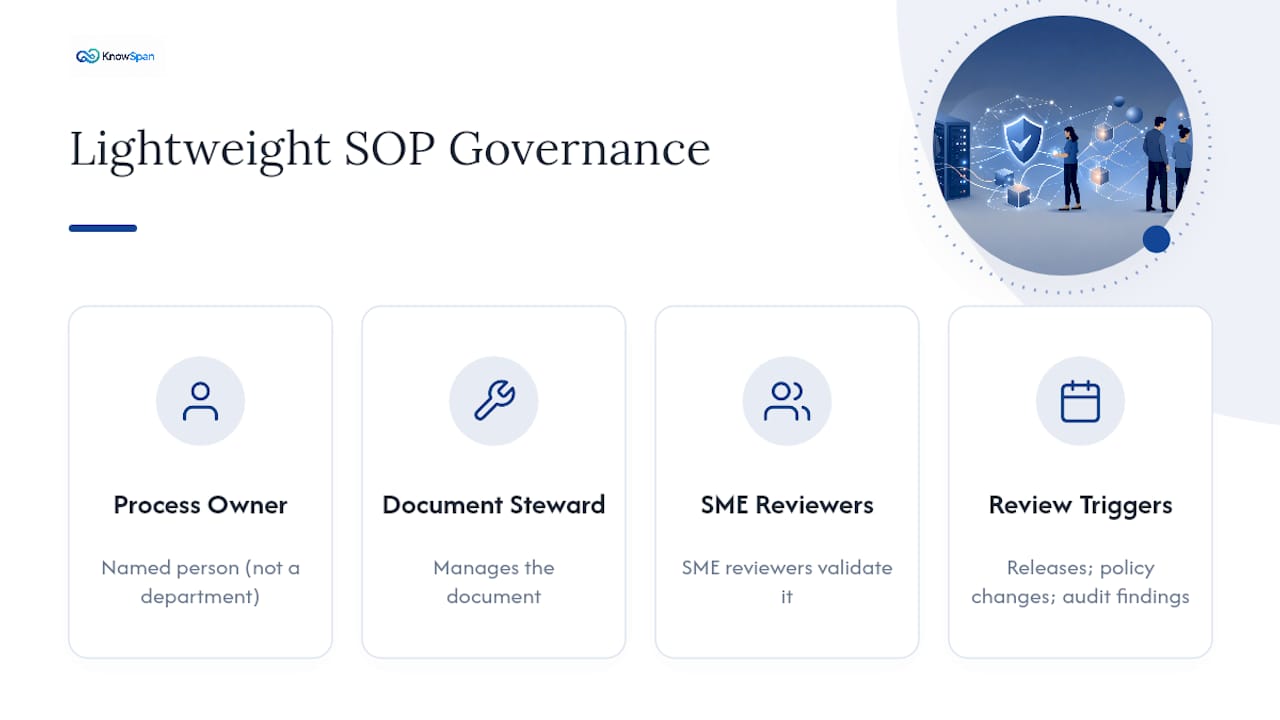
Keep governance lightweight. A steward who manages the document, SME reviewers who validate it, and a review cadence with clear triggers, releases, policy changes, audit findings, is enough. You don't need a committee.
A Repeatable Knowledge Verification Workflow You Can Run in a Week
You don't need a quarter-long project to verify your first batch of SOPs. Here's a workflow that fits inside a week, once you know which documents matter most.
- Prioritize by risk. Rank SOPs by how often they're used, how much damage a mistake causes, and how long it's been since anyone reviewed them. Focus on the top slice first rather than trying to verify everything at once.
- Assign the three roles. Name an accountable owner, a documentation steward to manage updates, and one or two SME reviewers to validate accuracy.
- Prepare the canonical version. Every SOP should carry a version number, an owner name, a last updated date, and a short change log. This metadata is what makes a document verification status meaningful instead of decorative.
- Run the live test. Have someone other than the author, ideally a successor or newer team member, execute the process step by step. Log every point of confusion as a backlog item.
- Publish and mark status. Update the document, mark it verified, and set a next review date tied to a trigger, not just a calendar reminder.
Pro Tip: Don't ask your best SME to write the SOP alone. Ask them to narrate a real recent case instead. You'll get the exception logic that a clean, idealized checklist always leaves out.
Audit Checklist and a 10 to 15 Minute Micro-Review Script
Full audits matter, but they're rare. Micro-reviews are what keep knowledge accurate between them. Run this checklist during either:
- Version number, owner name, and scope are current
- Inputs, steps, and decision points match how work actually happens
- Controls, required evidence, and system references are correct
- Dependencies on other teams or tools are listed
- Any metrics tied to the process still reflect reality
For the micro-review itself, walk through five things in ten to fifteen minutes: the sequence of steps, who owns each one, the decision rules, known exceptions, and the controls that catch errors. This short format matters because it fits into a busy SME's week. A quarterly audit paired with regular micro-reviews catches drift long before it shows up in a client complaint or an audit finding.
Route anything that doesn't check out into a "drift inbox," a simple queue of flagged issues waiting for a fix. Track how much SME time each review actually takes. If it's creeping past fifteen minutes, the SOP itself is probably too complicated.
Who Owns What, and How a Governed Platform Helps
Clear roles prevent verification from collapsing into "someone should probably check that." The process owner is accountable for the outcome. The steward handles the operational work: scheduling reviews, updating metadata, chasing SMEs. SME reviewers are consulted to confirm the details are still right.
Beyond roles, a handful of signals tell you whether your knowledge base is healthy or quietly rotting:
| Signal | What it tells you | |---|---| | Verification status | Whether an SOP has passed a live trial recently | | Last updated / next review date | How stale a document is and when it's due | | Continuity score | How exposed the business is to a single point of failure | | Unresolved question backlog | Where employees are stuck and nobody has answered yet |
MindVault, Knowspan's operational knowledge platform, tracks each of these natively. Its Operational Continuity dashboard flags stale documentation and key-person dependency before they become emergencies, while the Continuity Scorecard gives leaders a benchmark to track over time. A healthy dashboard shows rising verification rates, shrinking backlog, and no single owner covering more processes than they can realistically maintain.
A 30-Day Sprint to Prove Verification Works
You don't need a year-long rollout to see results. A focused month works.
- Week 1: Audit. Export your full SOP list. Score each one by risk, frequency, and last review date. Pick the riskiest 10 to 20 percent.
- Week 2: Assign. Name an owner, steward, and SME reviewer for each prioritized SOP. Add version, owner, and last updated metadata to every document.
- Week 3: Test. Run live trials or successor executions. Capture every gap as a backlog item and rank it by severity.
- Week 4: Fix and publish. Resolve the highest priority gaps, publish verified versions, mark their status, and set review cadences with real triggers attached.
What Actually Goes Wrong With Verification Projects
The biggest mistake is asking your best expert to write everything down alone. That produces clean steps and skips the judgment calls that actually matter. The second mistake is skipping ownership entirely and assuming "the team knows this."
Quick wins are real. You can verify your riskiest ten SOPs in a month. Keeping that pace going for a year is a cultural shift, not a project with an end date.
— Jack
Where MindVault Fits Into Your Verification Process
Spreadsheets and shared drives can get you through your first verification sprint. They start to break down once you're managing dozens of SOPs across multiple departments, tracking review cadences, and trying to prove audit readiness to a client or regulator.
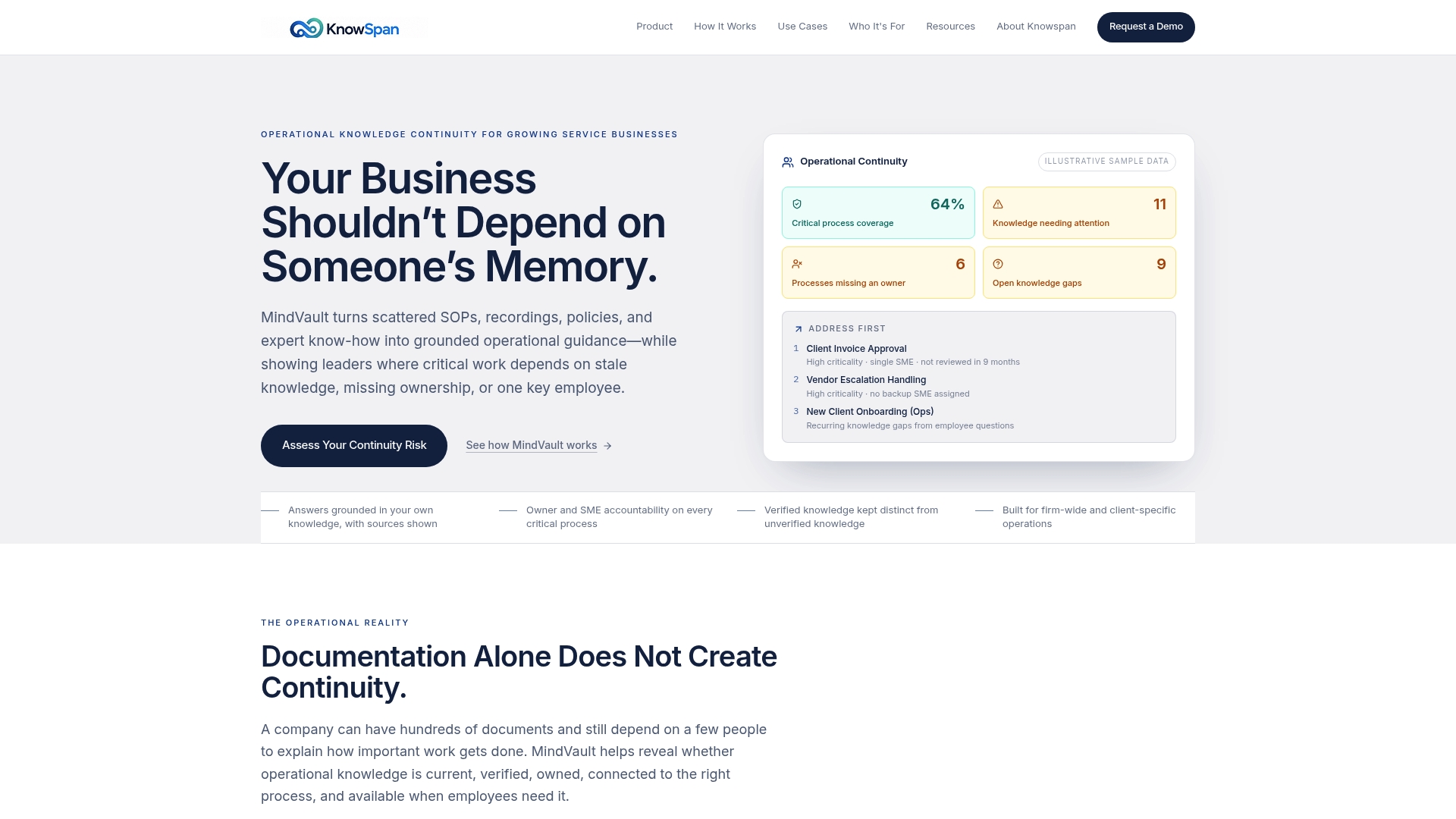
MindVault, Knowspan's operational knowledge and continuity platform, was built for exactly that scale. It attaches verification metadata, owner, steward, review status, next review date, directly to every process, so nothing goes stale unnoticed. The Operational Continuity dashboard shows leaders precisely where the business depends on outdated documentation or one irreplaceable employee. Unresolved employee questions get tracked as a backlog instead of quietly repeating in Slack threads. If your business has outgrown ad hoc documentation and is starting to feel exposed to key-person risk, especially in accounting, property management, or managed IT services, it's worth assessing your continuity risk directly. From there, you can walk through how the platform works and see whether a governed system fits your next stage of growth.
Sources
For deeper reading on the process, see ClearWork's governance and review cycle guide, Verti's tribal knowledge capture guide, and BASG's continuity playbook. For assigning clear ownership around compliance-heavy finance processes, TLC Consulting's compliance resources are a solid companion.
- How to Keep SOPs Current (2026): Governance + Review Cycles That Don’t Die in Month 2
- The Hidden Cost of Operational Knowledge Management in Service Businesses
FAQ
What Is Knowledge Verification?
Knowledge verification is the process of confirming an SOP or documented procedure is accurate, has a named owner, and can be executed successfully by someone other than the person who wrote it. It typically involves a live trial run or a successor execution test, not just a document review.
How Often Should SOPs Be Reviewed?
Most teams run a full audit quarterly, paired with shorter micro-reviews in between, using a 10 to 15 minute format. Reviews should also trigger automatically after releases, policy changes, KPI drift, or audit findings, not just on a fixed calendar.
Who Should Own an SOP?
A single named person, never a department, should be accountable for each SOP. That owner works alongside a documentation steward who manages updates and one or two SME reviewers who validate accuracy during reviews.
What's the Difference Between a Document Review and a Verification?
A review checks whether the words on the page still make sense. Verification goes further: it tests whether someone can actually execute the process using only that document, exposing missing steps or unclear decision points a review would miss.
Can Software Help With Knowledge Verification?
Yes. A platform like MindVault tracks verification status, review cadence, and ownership directly on each SOP, and its Operational Continuity dashboard flags stale documentation or single-person dependencies before they cause an outage. Spreadsheets can work at small scale, but they don't surface those risks automatically.
Recommended
This article was researched and drafted with AI assistance and reviewed by the KnowSpan team before publishing. It's provided for general informational purposes and isn't a substitute for professional legal, compliance, or IT advisory services. For guidance specific to your organization, please consult a qualified professional or contact us directly.