
Service Ops: 3 SOP Governance Moves That Make Docs Audit Ready
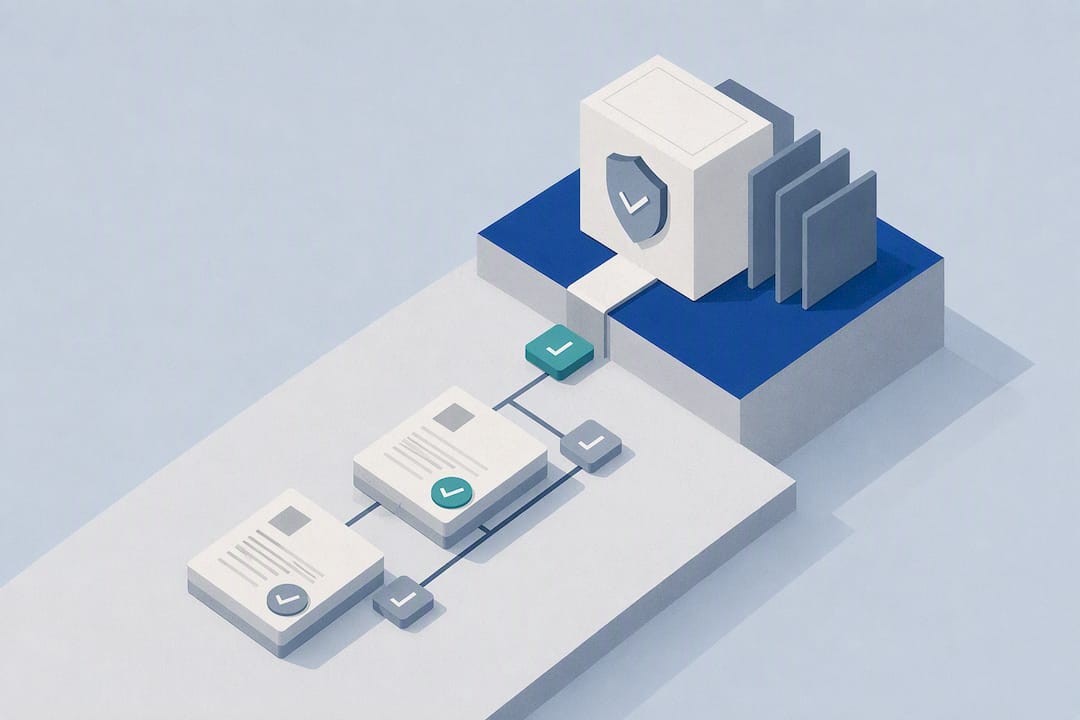
SOP governance is the system of roles, workflows, and controls that keeps standard operating procedures accurate, owned, and traceable over time. It is not the SOPs themselves. The fastest fix for most organizations: assign a named owner to every process and set a fixed review cadence, so nothing goes stale without someone accountable for catching it.
TL;DR:
- Assign a specific owner to each SOP and set clear review schedules to prevent procedures from becoming outdated and ensure accountability.
- Implement risk-based approval workflows with minimal roles—process owner, documentation steward, and SME reviewers—to streamline updates and reduce bottlenecks.
- Track evidence at each SOP lifecycle stage, including testing, approval, training, and review, to maintain a complete documentation trail for audits.
- Use version control with unique identifiers, major-minor numbering, and a single source of truth to avoid chaos from multiple copies and outdated versions.
- Automate training completion, approval routing, and review reminders to maintain process accuracy and reduce manual oversight.
Table of Contents
- What Does SOP Governance Actually Cover?
- Building a Governance Framework That Won't Collapse Into Bureaucracy
- What Happens at Each Stage of the SOP Lifecycle?
- How Should Version Control Work in Practice?
- When Should You Actually Review an SOP?
- What Should You Automate, and What Should Stay Manual?
- Three Moves That Fix Most Broken SOP Programs
- How MindVault Puts SOP Governance Into Practice
- Sources
- FAQ
What Does SOP Governance Actually Cover?
Most people think SOP governance means "having a document library." It doesn't. Governance is the operating layer around the documents: who writes them, who approves them, when they get reviewed, and how you prove any of that happened.
This distinction matters because a folder full of well-written procedures with no owner behind them decays fast. Someone leaves, a process changes, and the SOP quietly stops matching reality. Nobody notices until an audit, a client complaint, or a new hire follows outdated steps.
Regulators and auditors know this pattern well. In regulated environments, SOP governance is treated as foundational because governance failures tend to signal broader quality problems. An outdated procedure rarely shows up alone. It's usually a symptom of missing ownership, skipped reviews, or a broken approval chain.
A working SOP governance framework, at minimum, needs to define:
- Who owns each procedure and who can approve changes to it
- How often each SOP gets reviewed, and what triggers an off-cycle review
- How versions are tracked, issued, and retired
- What evidence proves employees were trained on the current version
- Who steps in when the primary owner leaves or changes roles
The EPA's own guidance on quality-related SOPs backs this up structurally. It recommends specific document sections and review responsibilities baked into every procedure, not left to informal habit. That's the difference between a document and a governed process: the rules for maintaining it are written down, too.
Building a Governance Framework That Won't Collapse Into Bureaucracy
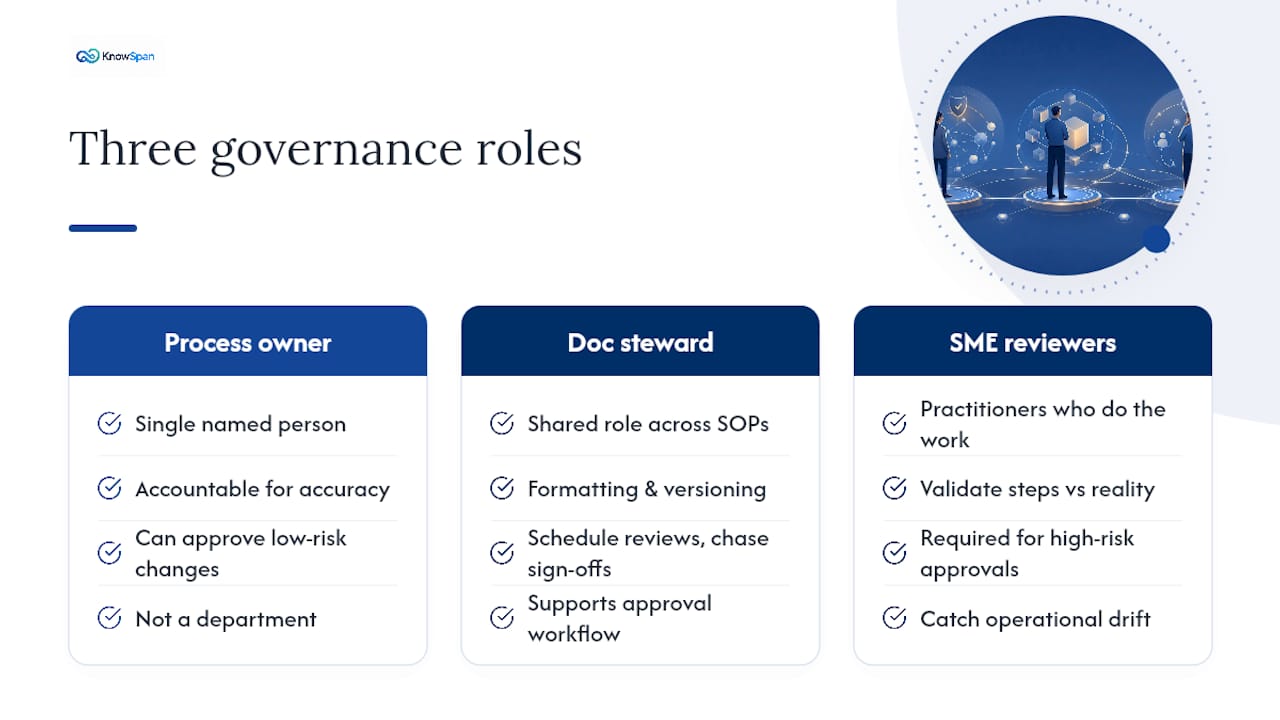
Most SOP governance efforts fail for one of two reasons: no ownership, or too much process. Skip the second failure mode by keeping the model to three roles.
1. Process owner. One named person accountable for the procedure's accuracy. Not a department. Not "the team." One person whose name is on it.
2. Documentation steward. Someone who manages the mechanics: formatting, version numbers, scheduling reviews, chasing overdue sign-offs. This role can be shared across many SOPs.
3. SME reviewers. The people who actually do the work and can catch when a written step no longer matches reality.
Approval rules should scale with risk, not apply uniformly. A low-risk internal checklist might need only the process owner's sign-off. A client-facing compliance procedure or anything tied to safety or regulatory exposure should require the SME reviewer and a second approver before it goes live.
Practitioner evidence backs a lean structure here: lightweight governance models with clear ownership and risk-based approvals outperform heavier committee-based systems, mainly because they don't create bottlenecks nobody wants to push through.
Pro Tip: Resist the urge to route every SOP change through the same approval chain. A typo fix and a change to a client onboarding procedure carry different risk. Treat them differently, or your team will start skipping the process entirely.
The goal isn't more oversight. It's making sure someone is watching each procedure without turning every update into a multi-week approval slog.
What Happens at Each Stage of the SOP Lifecycle?
Every SOP moves through the same basic stages, and governance means capturing evidence at each one. Skip the evidence and you have a document trail with holes in it.
Drafting and testing. SMEs draft the procedure, and someone other than the author should test it against real work before it goes to approval. The EPA's guidance specifically recommends testing drafts with other users before finalizing, catching gaps the original writer missed.
Approval and effective date. Approval and "effective" are not the same moment. A procedure isn't live until the people who use it have been trained on it. Linking the effective date to completed training is one of the strongest controls an auditor looks for.
Issuance and use. Only the current version should be reachable at the point of work. If old copies are still sitting in a shared drive, someone will eventually follow them.
Periodic review. Reviews should happen on a schedule, not "whenever someone remembers."
Revision and retirement. Changes trigger a new version number and a fresh training cycle. Retired SOPs get archived, not deleted, with their history intact.
A few things worth recording at each step:
- Who drafted and who tested the procedure
- Approval signatures and the approval date versus the effective date
- Training completion tied to the current version number
- Review dates and what changed at each review
- Retirement date and the reason a procedure was superseded
Miss any of these, and you can't reconstruct what happened when an auditor or a new manager asks.
How Should Version Control Work in Practice?
Every SOP needs a unique identifier and a version number that means something. A common convention: major.minor versioning, where a minor update (a typo, a clarified sentence) increments the minor version number while a substantive process change increments the major version number. That distinction alone tells reviewers how much scrutiny a change needs.
Version control best practices call for keeping full revision history alongside the current version, and making sure obsolete copies are pulled from anywhere staff might actually access them. A PDF sitting in an old shared drive folder is a liability, not an archive, if someone can still open and follow it.
Two dates matter more than people realize:
- Approval date: when the right people signed off on the content
- Effective date: when the procedure actually goes live for use
These should never be the same date unless training happened instantly, which it usually doesn't. The gap between them is where training gets scheduled and completed.
- Assign a permanent unique ID to every SOP, independent of its title
- Use major.minor version numbers so the size of a change is visible at a glance
- Keep one canonical source of truth. Every other copy should be read-only or removed
- Archive retired versions with their full history. Never delete them outright
A single canonical source matters more than most teams admit. If your SOPs live in three different systems, a printed binder, and someone's local drive, you don't have version control. You have version chaos with a filing system.
When Should You Actually Review an SOP?
Cadence should match how much a process changes, not a blanket annual rule applied to everything. A stable back-office procedure might only need review every 18 to 24 months. A process tied to a fast-changing tool or regulation might need quarterly checks. High-change client-facing workflows might warrant a review every 60 to 90 days.
Cadence alone won't catch everything. Certain events should force an immediate review, regardless of schedule:
- A tool, system, or vendor tied to the process changes
- A KPI or error rate tied to the process starts drifting
- An audit or internal review flags a discrepancy
- The process owner or an approver leaves or changes roles
- A client or regulator raises a complaint tied to the procedure
Waiting for the scheduled review date after one of these events is how documentation quietly falls behind reality.
One practical pattern worth adopting: a "drift inbox," where anyone who notices a procedure doesn't match reality can flag it without waiting for the formal review cycle. Paired with a short micro-review of 10 to 15 minutes, this catches small drift before it becomes a bigger gap. It keeps high-change processes accurate without requiring a full committee review every time something shifts slightly.
What Should You Automate, and What Should Stay Manual?
Automation earns its keep in a few specific places. Effective dates can be enforced automatically, so a revised SOP doesn't go live until training assignments are complete. Training completion tracking removes the manual chase of spreadsheets and email reminders. Audit trails, capturing who approved what and when, should be automatic by default, not reconstructed after the fact.
Tying training completion to the effective date is one of the most effective controls available, since inspectors specifically look for proof that people were trained on the version they're actually using, not an older one.
What shouldn't be automated: the approval judgment itself. Automation can route a document to the right approver and remind them it's overdue. It should never decide, on its own, that a procedure is fine to publish. SME judgment on whether a step still reflects real work isn't something a workflow tool can replace.
For organizations managing hundreds of SOPs, staggering review dates across the calendar avoids a bottleneck where every procedure comes due at once. A dashboard that surfaces overdue reviews and flags single-person dependencies gives leaders a way to catch coverage gaps before they become emergencies, rather than after someone quits.
Three Moves That Fix Most Broken SOP Programs
Most SOP governance problems trace back to the same root cause: nobody owns the document, so nobody notices when it's wrong. Fix that first. Name an owner for every procedure before worrying about templates or formatting.
Second, set event triggers, not just a calendar date. A cadence-only system misses the SOP that goes stale the week after a tool changes, not on its annual review date.
Third, pick one canonical source of truth and kill every duplicate copy. I've seen teams run three "current" versions of the same onboarding checklist across a shared drive, a wiki, and someone's desktop. Nobody was lying. Nobody was auditing, either.
Governance isn't paperwork for its own sake. It's what keeps a business running when the one person who knows a process is out sick, or gone for good.
— Jack
How MindVault Puts SOP Governance Into Practice
Everything covered above (named owners, review cadence, version control, training evidence) is easier to enforce with a system built for it than with a shared drive and good intentions. MindVault is Knowspan's operational knowledge and continuity platform, and it maps directly to that governance checklist.
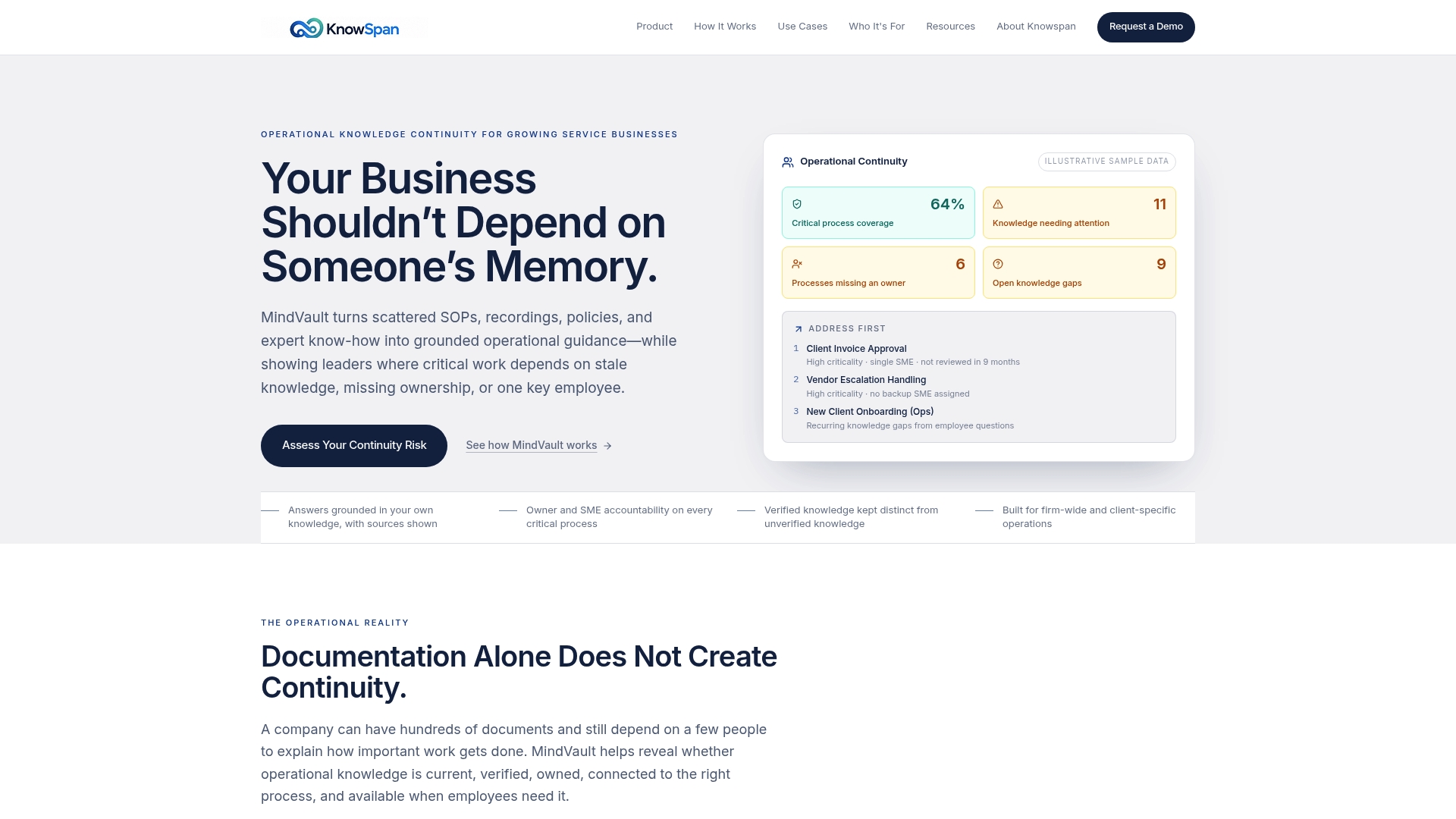
Every process in MindVault ties to an accountable owner and subject-matter expert, so ownership never sits ambiguous. The platform tracks verification status and review cadence automatically, and its Operational Continuity dashboard shows leaders exactly where documentation has gone stale, where ownership is missing, or where a single employee is the only person who knows a process. It also turns unanswered employee questions into a tracked backlog, so knowledge gaps get resolved by an SME instead of quietly repeating.
If you're not sure where your organization's biggest continuity risks sit, start with a structured continuity risk assessment or explore the full platform to see how governance, ownership, and audit-readiness come together in one system.
Sources
For readers who want to go straight to primary guidance, the EPA's document on quality assurance and SOP structure covers required sections, document control, and review responsibilities in detail. On the compliance side, 21 CFR Part 11 Compliance: A Practitioner's Playbook walks through electronic records and signature requirements relevant to regulated SOP environments. For lifecycle mechanics, including version control tied to training evidence, see this SOP management overview.
FAQ
What Are the Five Parts of an SOP?
Most SOP templates include a title with document control information, a purpose statement, a scope section, numbered procedure steps, and a quality assurance or verification check. Many frameworks also add a revision history section to track changes over time, which supports the audit trail auditors expect to see.
What Are the Four P's of Governance?
Definitions vary across industries, but a common framing centers on Policy, Process, People, and Performance: the rules that govern a procedure, the workflow itself, the roles accountable for it, and the metrics used to check it's working. In SOP governance specifically, this maps to your approval policy, your lifecycle workflow, your owner and steward roles, and your review outcomes.
What Is an SOP in a Government or Regulatory Context?
In a regulatory setting, an SOP is a documented, approved procedure that regulators expect to be current, accessible, and tied to proof that staff were trained on it. The EPA's guidance treats SOPs as controlled documents, not informal instructions, with defined review and document-control expectations.
What's the Difference Between SOPs and SOP Governance?
An SOP is a single document describing how to perform a task. SOP governance is the system around it, covering ownership, approval rules, review cadence, and version control that keeps that document accurate over time. You can have a well-written SOP with no governance behind it, which is exactly how procedures go stale without anyone noticing.
Does MindVault Track SOP Review Cadence and Ownership?
Yes. MindVault ties every process to a named owner and subject-matter expert, tracks verification status and review cadence, and surfaces overdue reviews or missing ownership through its Operational Continuity dashboard. Pricing details are available directly on the MindVault site.
Recommended
This article was researched and drafted with AI assistance and reviewed by the KnowSpan team before publishing. It's provided for general informational purposes and isn't a substitute for professional legal, compliance, or IT advisory services. For guidance specific to your organization, please consult a qualified professional or contact us directly.